
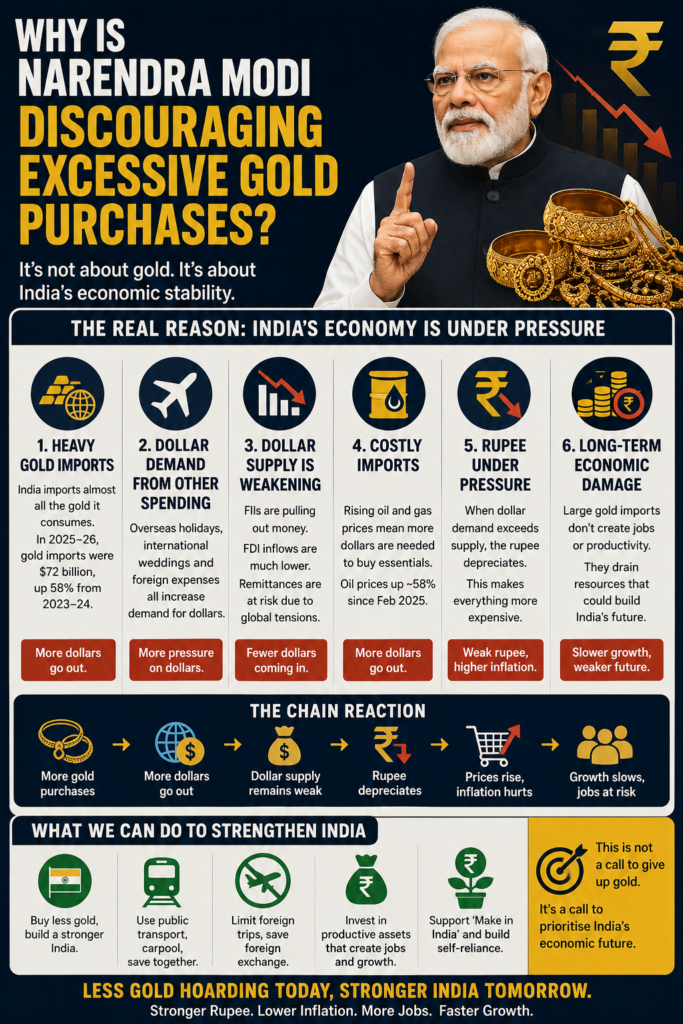
Why Modi Is Asking Indians to Buy Less Gold
India’s relationship with gold is emotional, cultural, and deeply financial. For generations, gold has been seen as security, status, inheritance, and protection against uncertain times. From weddings to festivals to family savings, gold occupies a special place in Indian households.
But Prime Minister Narendra Modi recently made an unusual appeal: avoid buying gold jewellery for a year if possible.
At first glance, this sounds surprising in a country where gold demand is woven into everyday life. But behind this statement lies a much bigger economic concern — India’s growing pressure on dollars, the weakening rupee, rising oil prices, and the fear of a widening economic imbalance.
Economist Vivek Kaul argues that this is not really a campaign against gold itself. It is a warning about the structural pressure building inside the Indian economy.
India’s Gold Obsession Comes at a Dollar Cost
India imports almost all the gold it consumes. Unlike countries that mine large quantities domestically, India must buy gold from abroad — and those purchases are paid for in US dollars.
That means every time Indians collectively buy massive amounts of gold, the country needs more dollars to pay foreign sellers.
In 2025–26, India’s gold import bill reportedly surged to around $72 billion, sharply higher than previous years. Even though import volumes slightly declined, rising global gold prices pushed the total bill much higher.
At the household level, buying gold makes sense:
- It protects savings from inflation.
- It acts as a hedge when the rupee weakens.
- It provides psychological security.
- It is easy to pass across generations.
But when millions of households do the same thing simultaneously, the macroeconomic impact becomes serious.
Gold does not generate exports.
Gold does not create factories.
Gold sitting in lockers does not produce jobs.
From the perspective of policymakers, it becomes a large dollar outflow with limited productive economic return.
Why the Timing Matters Now
Under normal conditions, India can manage large gold imports. But the current global environment is far from normal.
The war in West Asia has sharply increased uncertainty in energy markets. Oil prices have risen dramatically, and India imports nearly 90 percent of its crude oil requirements.
Oil imports are also paid in dollars.
So now India faces a double pressure:
- More dollars are needed to buy oil and gas.
- More dollars are being spent on gold imports.
At the same time, dollar inflows into India are weakening.
Foreign institutional investors (FIIs) have been selling Indian stocks and taking money out of the country. Foreign direct investment inflows have slowed compared with earlier years. Remittances from West Asia may weaken if regional instability continues. Even India’s IT export growth has moderated.
The result is simple economics:
When demand for dollars rises faster than supply, the dollar becomes more expensive.
That means the rupee weakens.
What Happens When the Rupee Weakens?
A depreciating rupee affects almost everything in the economy.
India must spend more rupees to buy the same amount of oil, gas, electronics, machinery, and imported goods. This pushes inflation higher.
Petrol and diesel prices rise.
Transportation costs rise.
Imported products become more expensive.
Business costs increase.
Eventually, ordinary households feel the impact through higher living costs.
This is why economists worry about the “current account deficit” — the gap between the dollars leaving India and the dollars entering it.
If too many dollars flow out and too few come in, pressure on the rupee intensifies.
Gold Is Rational for Individuals — But Difficult for the Economy
One of the most important points in this debate is that households are not behaving irrationally.
In fact, many Indians buy gold precisely because they do not fully trust paper assets, volatile markets, or inflation-adjusted returns.
Gold has historically protected wealth during uncertainty.
So there is a contradiction:
- At the individual level, buying gold feels financially safe.
- At the national level, excessive gold imports create pressure on the economy.
This is the behavioural conflict Vivek Kaul highlights.
When people expect the rupee to weaken, gold becomes even more attractive — because gold prices often rise alongside currency depreciation.
In that sense, gold buying is not just cultural.
It is defensive economic behaviour.
Modi’s Message: “Control the Controllable”
Seen in this context, Modi’s appeal makes more sense.
Alongside discouraging excessive gold purchases, he also urged people to:
- reduce unnecessary foreign travel,
- avoid expensive destination weddings abroad,
- use public transport,
- and cut avoidable dollar spending.
The idea is straightforward:
India cannot immediately control global oil prices or geopolitical wars.
But it can try to reduce avoidable dollar outflows.
The message is less about banning gold and more about managing economic pressure during a vulnerable period.
The Bigger Structural Problem
The deeper issue is that India still relies heavily on imports for critical needs:
- oil,
- natural gas,
- electronics,
- defence equipment,
- and precious metals like gold.
At the same time, India needs stronger export growth, manufacturing expansion, and sustained foreign investment inflows to balance those imports.
Without that balance, every global shock — whether war, oil spikes, or capital outflows — puts stress on the rupee.
Gold simply becomes one visible symbol of that imbalance.
Conclusion
India’s love for gold is unlikely to disappear. It is rooted in culture, memory, family tradition, and economic insecurity.
But Modi’s warning reflects growing concern that the country is entering a period where dollars matter more than ever.
When oil prices rise, foreign investment slows, and global uncertainty increases, large gold imports become harder for the economy to absorb.
The debate is no longer just about jewellery.
It is about:
- the strength of the rupee,
- inflation,
- India’s dependence on imports,
- and whether household savings are flowing into productive investments or locked away in vaults.
In the end, the government’s message is clear:
Less dollar drain today could mean a more stable economy tomorrow.